Woodwind and brass stands are specialized supports designed to hold your instrument securely when they are not being played. Look for good stability and make sure the sections of the stand which come into contact with you instrument are padded in order to avoid damaging your instrument. A good stand will prevent damage to your instrument by holding it securely, offer a safe place to put the instrument during practice, rehearsal or performance when you may need to swap from one instrument to another, and can help maintain the instruments condition by preventing any undue stress on the body of the instrument and the key and valve mechanisms. I also think that, especially for wind and brass instruments, leaving your instrument on a stand helps it dry after use.
Some of the stands have quite fragile legs, which is why for example, I prefer the K&M 152/3 to the K&M 15232 Compact Flute Stand, but the compact models do fold down to a really small size which can be a consideration when travelling. (Double bass players will snigger at that!)
If you need stands for multiple instruments, Hercules have some of the best offerings on the market.
Cello and double bass stands are essential for safely storing and displaying these larger string instruments when they’re not in use. Although there are wall hangers available, I’ve never really found a satisfactory one – I think the instruments are simply too big in the body – and would always go for a sturdy floor stand. Both K&M and Hercules have good offeringss in the mid-to-high price range. While they may be more expensive than some basic models, in each case the quality, durability, and features more than justify the investment. For me, they offer excellent value for money, especially for serious musicians who need a reliable stand.
The K&M 141/1 Cello Stand is renowned for its quality and durability, making it a popular choice among cellists. This stand is constructed with high-quality materials, featuring a sturdy metal frame, wide base, rubberise supports, and a cushioned backrest to ensure the cello is securely held without any risk of damage or scratches. The stand’s build quality is robust, providing long-lasting durability. I also like the adjustable arms which means it will hold various sizes of cello securely
Cello Stands
It is also relatively lightweight and foldable, which makes it reasonably portable (and lets’ face it cellos are bulky enough to carry round, especially on public transport, so every little helps), allowing cellists to transport it easily to rehearsals, performances, or lessons. The compact folding design is also is convenient to store when not in use.
Despite its solid construction, the Hercules DS580B is relatively lightweight and foldable, making it easy to transport. It folds down to a compact size, which is convenient for storage and travel.
Stability is a key feature of the Hercules DS580B stand. It boasts a wide base with non-slip rubber feet that prevent it from slipping on various surfaces.
The stand has a sleek and modern appearance with a clean design that fits well in various environments, from home studios to concert stages.
As a budget option this Cobra stand seems quite good, but I haven’t had enough experience of this stand to fully assess it. However, at £32.95, a 4.4 star rating on Amazon, and coming with a 2-year warranty it seems to be a decent offering for the price.
Double Bass Stands
For double bass players, the K&M 141 model Double Bass Stand is a sturdy (vital with such a large instrument) and adjustable floor stand. The soft rubber covered adjusting arms will hold you bass securely. Pretty much the best stand out there for basses in my opinion.
The Hercules offering is the Hercules DS590B. As with all Hercules stands, it has a good solid construction, but lacks a bow holder and a neck brace, which I think is a disadvantage, especially on such a large and expensive instrument.
When selecting a keyboard stand, it’s worth taking some time to consider the following factors:
How much does your keyboard weigh and will the stand you are considering support the weight of your keyboard. You will need a more stable stand such as a Z style or table-style stand if you have a heavy keyboard stand or a have a rigorous playing style. Also check the adjustability of the height and width to make sure you can get a comfortable playing position.
If you need to transport the stand frequently for gigging, look at good lightweight and foldable stands. Additionally, some stands come with additional tiers or racks for extra equipment.
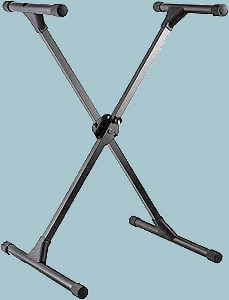
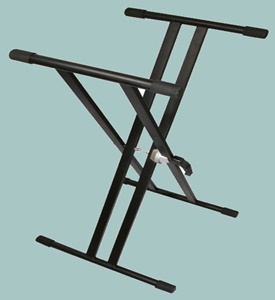
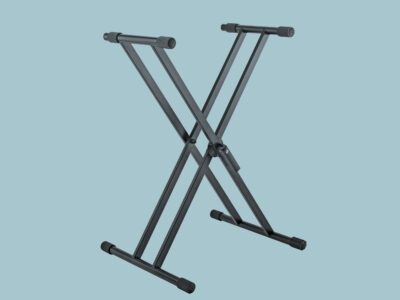
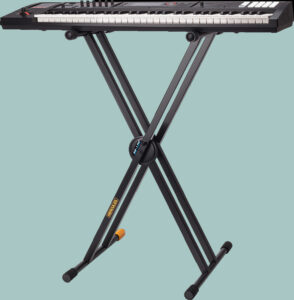
X-Style Stands have an “X” shape and are one of the most common types due to their affordability and portability. These tend to be lightweight and easy to fold and transport. The downside is that they may not be as stable for heavier keyboards and can have limited adjustability in width (there are usually only 4 settings). They stands can be single or double brace (i.e double X), with the double brace style stands giving better stability. The biggest drawback with X style stands is playing your keyboard in the seated position. As soon as you sit down, it’s hard to position yourself without knocking your knees into the brace, which in true domino style can result in the keyboard getting knocked off the stand.
Our choice for single X style stands are:
TGI TGKS1K&M37230Hercules KS100B
And for double brace stands, which are more solid than single brace ones, the following are good options:
TGI TGKS2K&M 18990Hercules KS120B
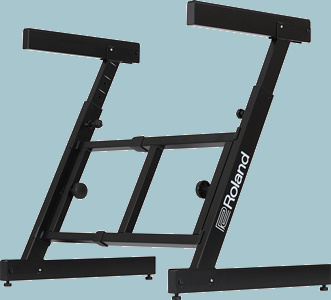
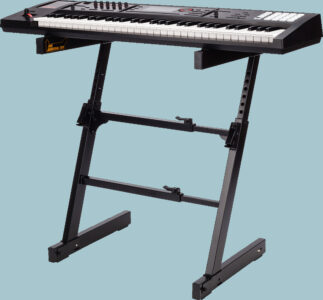
Z-Style Stands have a “Z” shape, providing better stability and more surface area for the keyboard. They tend to be more stable that the X style stands and can support heavier keyboards. This does make them heavier and bulkier to transport. I like the Roland KS 11Z and the Hercules KS400B. Neither are cheap, but they give good support to your (possibly quite expensive) keyboard.
The Roland KS 11Z is one of the best around – a really solid stand at 10 kg. The KS-11Z provides a robust and stable platform which can handle portable keyboards and pianos with up to 88 keys and weighing up to 100kg. There are multiple adjustment points which allows you to tailor the width and height to your keyboard: There is a quick release lever for the width adjustment of between 566mm and 940mm and a spring-loaded for the height adjustment of 645mm to 917mm. The adjustable feet give good stability on uneven floors and the support arms a padded and fold down for transport and storage. The arms also quickly lock into place when putting the stand up. An impressive stand.
The Hercules KS-400B Z-Stand Keyboard Stand has a built-in AutoLock System which allows you to set the desired height by simply raising the arms with height parameters of 604.5mm to 929.6mm and you can adjust the width between 508mm and 851mm. There are fluorescent marks to allow you to adjust both arms evenly which is useful when on a dark or dimly lit stage. The locking pins give a quick and secure set up and adjustable feet give a good stable setup. Weighing in at 8kg, it has an impressive load capacity of 127.9kg
Of the more affordable options, Rockjam has a pretty good offering.
Roland KS 11z Hercules KS400BRockjam
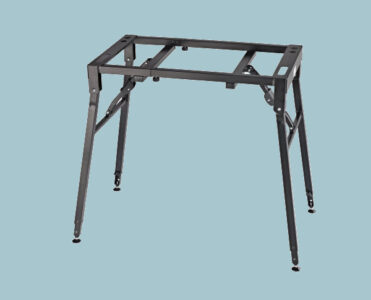
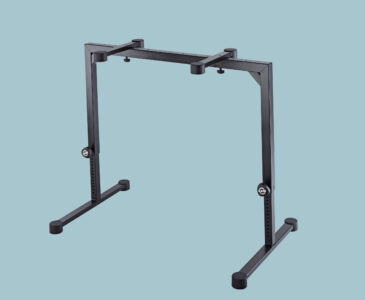
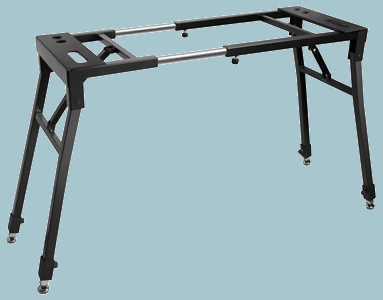
Table-Style Stands resemble a small table and often come with additional features like racks for gear. They are very stable, offer height adjustability and can hold additional equipment, but they tend to be very heavy (i.e. not as portable) and more expensive than other stands.
A couple of the K&M models are our best picks if you need a quality, robust stand, but TGI do a good offering as well.
The K&M 18950 is a high quality, steel-made table style keyboard stand. Because the legs can be individually adjusted and each leg has levelling feet, and non-slip rubber pads, it is a very stable stand. The height adjustment is from 600mm to 1,000 mm, and can take a second keyboard if needed. Weighing in at 10.7 kg it has a maximum load capacity is 80kg. As you can see here, it folds down really neatly as well.
The other K&M offering I quite like is Omega 18810. It’s very stable and robust keyboard stand (9.2kg) which has a spring-loaded height adjustment and is quick to assemble The support depth is 345mm, width is from 180mm to 790mm and the height ranges from 600mm to 1020 mm. You can also bolt on a range of attachments such as ipad and tablet holder, mic stands and even has 4 velcro tapes for cable management. All in all, quite an impressive offering.
If you don’t want to spend quite so much, the TGKT1 stand is pretty good as well. Weighing in at just under 9kg, it’s quite solid, and will support up to 80kg, giving it the same capacity as the K&M 18950. The height range is 620mm – 790mm, the width is 710mm – 1020mm, and the depth is 320mm.
K&M18950K&M18810TGI TGKT1
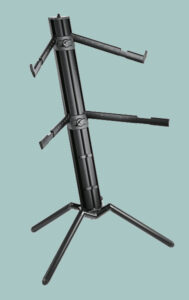
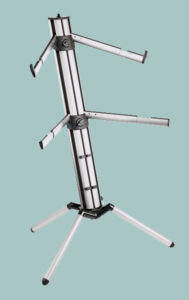
Column Stands have a central column with arms extending out to hold the keyboard. These stands offer good stability and often have multiple tiers for multiple keyboards. The design of these can be quite sleek, but they are often not as adjustable as other keyboard stands and can be bulky. If you are looking at these stands you are prepared to spend (they tend to be quite expensive) so I would just go for the best on the market which in my opinion is the K&M 18860 Spider Pro. There is no Hercules offering for this style of stand, The Spider Pro is an aluminium made stand has a tripod base with adjustable legs. This stand has an innovative double tiered design with arms coming out of a wide vertical spine of the stand with tripod base. The upper arms can also be moved to a 15 degree angle which allows easier access to the keyboard on the lower arms. You can also add additional support arms and attach a third keyboard. You can also attach microphone booms. It weighs 10.8 kg and the arms have weight capacity of 35kg per level. Extra arms and a carrying case can be purchased separately.
As with everything musical, there is a huge range to choose from. I always prefer to stay away from super cheap stands. Your instrument can be worth a lot of money, so why skimp on the stand and risk damage? After all, it’s better to spend a little bit of money on a stand rather than putting it down on a chair and sitting on it – anyone who has done this will never forget the sound of a shattering instrument. A good stand will also be designed to keep your instrument in good condition by avoiding improper storage. In a more professional situation, it’s easier to manage the use of multiple instruments if good, well designed stands are used, and in a domestic situation you’re more likely to play your instrument if you can see it – tucked away in a bag in the corner makes it easy to ignore!
My favourite instrument stand brands are Konig & Meyer (which come with 5 year guarantees) and Hercules. Both these brands, which in my many years in retail, have very, very low rates of returns, with TGI and Nomad giving good cheaper options.
Click on the links below to see our reviews on stands for your instrument.
Our favourite guitar stand supplier is Hercules. Originator of the auto-grab system, which is so convenient, these are good robust stands. Personally, I prefer stands which hold the neck (vital if you have children and dogs running around), but there are good A frames stands of you are short of space, or just want something compact. Wall hangers are a good choice, especially if you are short of floor space, but be careful not to position them above radiators or on outside walls.
This portable K&M A-frame guitar stand is suitable for acoustic, electric, and bass guitars. There is a push button system that enables adjustment for different types of guitars. This stand folds flat for easy transport and can also be used with guitars which have a nitrocellulose finish. As usual for K&M, this comes with K&M standard 5-year guarantee. Make sure you pick the correct one to hold your guitar (electric guitars are much thinner than classical and acoustic ones), but this model will work for all types.
This Hercules guitar stand also fits acoustic and electric guitars has hard rubber contacts and a special formulated foam which protects your guitar from scratches. Very compact design which will fit most gig bags as well. The design fits both acoustic and electric instruments and folds down enough to fit in gig bags. Very light weight at just 0.5kg.
Hercules guitar wall hangers are a great option, especially if you need to keep your guitars off the floor (you know – kids, pets, or just being a bit of a klutz). The have the Hercules Auto Grip System and we have used the slatwall version of these successfully for years. For home use the wood finishes are aesthetically pleasing. The grip mechanism itself uses specially formulated foam rubber fully protects your guitar and will take up to 7kg in weight.
For Multi-Guitar stands the K&M and Hercules are excellent choices.
A very simple idea to deal with a very awkward problem: I’ve got my music on a tablet but I’ve got to the bottom of the first of four pages. Now what? How do I turn the page when both my hands are on my instrument? Well not being Zaphod Beeblebrox* and not wishing to employ someone to lean over my shoulder or sit on the floor to push the button or swipe right I need a solution. Technical, not liquid (that comes later.) Well, the folk at IK Multimedia came up with a solution. Say Hello to your onstage companion for the duration of this concert, the iRig Blueturn.
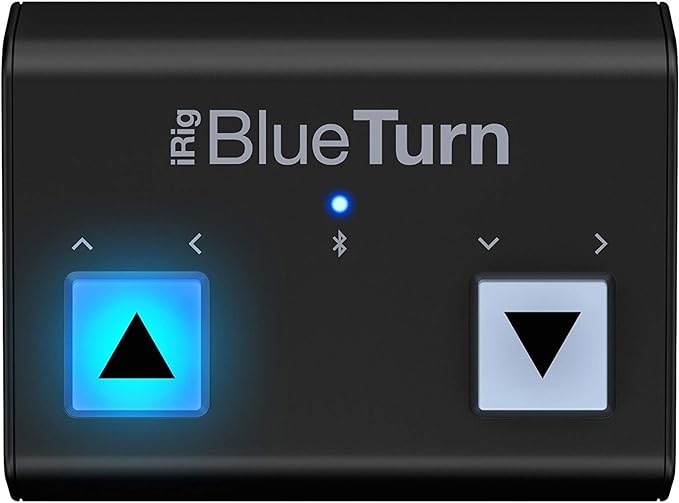
The dimensions of this piece of kit are 18.42 x 41.28 x 5.72 cm; and it weighs in at 119.07gms. It does need a couple of AAA batteries and to get you started there’s some in the box. Once you put those in you’ll notice the on-off switch underneath. That, and the two big white buttons (BWB) on the top are the only controls on the device. Do I need to tell you that the white ones are for your foot to stamp on though you’ll need to use your hands the first time you switch it on.
Switch it on. Well actually, don’t. you see this device has a few Modes that you need to understand before you do and you have an important decision to make. OK, now you know you have to decide we can turn it on. As this is your first time hold one of the BWBs down THEN turn it on. The BWBs will flash alternately. Now, pressing the Left button will put the device into Mode 1 and, obviously, the Right will put it into Mode 2. Pressing the Left and Right together will put you into Mode 3. So what are these modes?
Please make sure you have the up arrow foot switch on the left. Results can be unpredictable if you don’t
The manual says Mode 1 is the most common for IOS and Android devices. Well maybe. Possibly if you’re using the Irig Stage app. This mode is the Up Arrow foot switch is like pressing the Up Arrow on your keyboard and the Down Arrow is Down. With me so far?
If you go for Mode 2 the Up Arrow switch represent Page Up and the Down Arrow is Page Down . This is the one that works on my Android tablet but I suppose it depends on what you want the device to do as to which mode you end up choosing. Personally I would think that maybe Page Up/Down is what you might want the thing to do but you’ll need to experiment and see if the manual is right.
Mode 3: the Left (Up Arrow) switch sends a Left Arrow command and so, quite naturally, the Right (down arrow) represents a Right Arrow command.
Now you see why the original device orientation is important, and why, when you set out your stall, is important when in use. To help you, if the logo “BlueTurn” is upside down, so is the device.
You’re not out of the woods yet because you still have to pair it with your device. However, that bit is dead easy. Go to you Settings > Bluetooth section and you should see it there in Other Devices, or similar grouping, where you can select it to pair. No codes need to be entered to complete the paring.
In use, it works well and does exactly what it’s supposed to do. One caveat though. I’ve found that in direct on sunlight, even in the cold Summer days we have here in the UK (it’s mid-June as I write and the temperature is 16C) the device can stop working. Sometimes.
At the time of writing the RRP is £79.99 but you can get it at Amazon for £74.16, or Thomonn for £66.
*For those Earthlings not familiar with the Hitch Hikers Guide to the Galaxy, Zaphod Beeblebrox, President of said Galaxy, had a third arm fitted to help him with his ski-boxing.
I’ll be good, I promise, and try to avoid jokes about wind-up merchants, but I don’t promise nuffink. After all this is about a product whose whole purpose is winding things up. Well, strings anyway. On banjos, guitars, mandolins and ukuleles with breakdowns for different types of those instruments, And as if that wasn’t enough you can add in your own custom instruments and your own custom tunings. There’s 150 built-in tunings, yet you want more? Who do you think you are, Joni Mitchell?
Ok, so there’s an obvious difference between this string winder and many others out there. This one “knows” what the string you’ve attached it to should sound like and it will stop when it gets there. If it goes a bit past it, it will retune slightly until it’s right on. You can watch the progress on the built- in screen. when the tuning is right this winder give a little self-satisfied beep, which winds you up as well.
Oh, and it can also act as a metronome.
I tried it out on a number of instruments – a classical guitar, recently restrung, a Yamaha acoustic in standard tuning, a Fender acoustic in Open D. a Fender Telecaster, a Gretsch resonator (steel guitar) and a mandolin. This model doesn’t handle bass guitars.
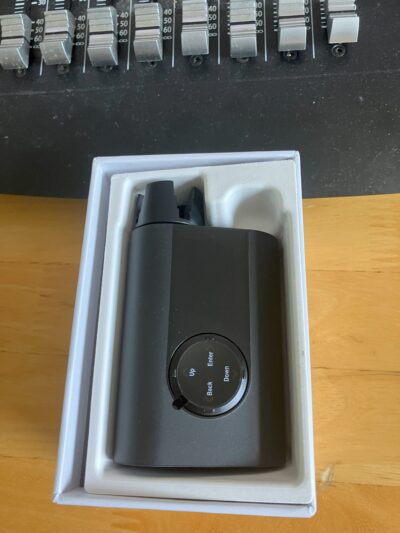
One word of warning. When you’re unpacking this device the cardboard moulded to the shape of the gadget fits the gadget OK, but doesn’t fit the box it comes in. It’s theoretically glued to the box but in my case this had come away. This may have happened in transit as a result of being shaken for some time, but still, be careful. This isn’t a cheap device and if you insist on dropping it on things, try to make sure they’re padded.
Given that this device is also marketed as being useful to people “on the road” soft cover would be useful to prevent damage, especially considering the price. You can buy a hard case for it. RRP £29
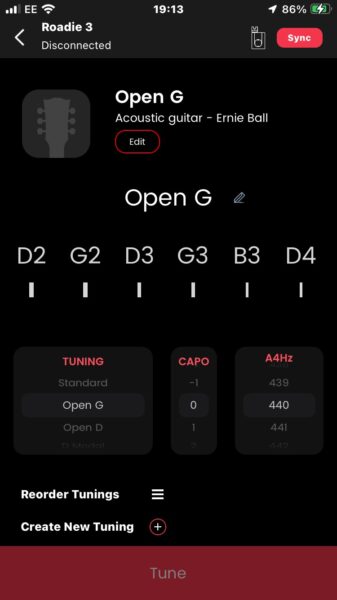
This comes with an app to download. Do so and use it. You can enter your instruments and enter their names and all details one letter at a time,. scrolling through the alphabet, but even Stephen Hawking found a better way than that. Use the app. it will save your sanity. Because….. you can do things on the app you can’t do on the device, like picking the tuning you want.
What you’ve got here is a screenshot showing what you get when you select an instrument in the app. You get shown what each string will get tuned to, you can change the tuning in that little box marked Tuning (swipe up or down), and you’ll have noticed the really clever bit. You can set this up so that you can stick a capo on, say, the 3rd fret and have the winder get you the right tuning, so you’re not in Open G but B-flat.
So what’s it like to use? Well there’s a fair bit of torque in the motor so you have to keep a pretty strong grip on it. It’s also quick, apparently a lot quicker than it’s predecessor (so I’m told) and a lot quicker than other powered winders I’ve used. You do also have to keep plucking the string you’re tuning. It won’t do anything unless you do that. It doesn’t ‘listen’ to the note using a mic but instead relies on the vibrations from the string. useful in noisy environments, and essential for tuning an electric guitar. Yes, they actually don’t need to be plugged in to anything, you just tune them like an acoustic.
It can be a bit awkward if you’ve got the guitar resting on your knee. it’s better if you can place the guitar on a rest or something that allows you access to the headstock. Otherwise you’re likely to brush the control button and maybe stop the tuning process. That means starting again. You can just pick one string, useful if you’re replacing a string on stage, but if you’ve just got to the G string it’s quicker to start again rather than select three strings manually.
When you’ve tuned all the strings, start again anyway. Changing ther tension in any string can change the torsion in the neck and affect the tuning of strings you’ve already tuned. It’s not the device’s fault, you just can’t beat Physics. There’s also a setting called Accuracy: you can set it to Fast or High Accuracy. In a quiet room it didn’t seem to make much difference.
It tuned the mandolin in under two minutes and each string was exactly the same as its twin. Three guitars were tuned in under five minutes. The classical guitar had just been restrung and the strings were slack. it took just a few seconds to go from slack to tuned. The electric guitar was tuned to perfection in under 20 seconds, the Yamaha in 30 seconds. It struggled a little with the resonator though but just on the top E string. That took close to a minute., but this may be because I hadn’t selected the “correct” option for the type of guitar. My three options were Lap Steel, Dobro round neck or Custom. I chose the last, maybe I should have chosen one of the others. After all this device is all about good vibrations and a resonator has a lot of those.
If all else fails there’s a manual tuning option, just like the various tuning apps you can get for your phone.
You can use this device to take a string off your instrument, and restring it using the WInder mode, which has 3 paces. You can unwind fas, put the new string on select the string note that you’re changing, press and hold the button and that 120RPM motor will whizz it up for you you and stop at the right note. In theory. It can be a little precious in doing that.
The battery is supposed to be able to handle 150 strings being tuned before it needs a recharge (USB-C cable supplied).
The claim is made that if your instrument has geared pegs then this device can tune it, so if you play the violin or viola you’re out of luck. Maybe. You probably have a violin which relies on friction to keep it in tune, you know, pull, tune, push, check. Swear. Start again. For. Each. String! Or you could buy a set of geared pegs. These will set you back anything from just under a tenner to £200 for a set. Now this gadget will work for you as well.
This is an impressive little device (it’s smaller than the palm of my hand, but I have reasonably large hands (stretching to 10 white notes on the piano – not up there with Liszt or Poulenc but not baby paws). First contact, it feels like it’s worth the £129 RRP (£107.50 at the time of writing). If you’re playing regularly on stage and under lights it might well be worth having one to give your axe a quick sharpening when you feel it’s needed. Get one for your roadie. For me, i do most of my playing these days on the beach, in the hot sun where sometimes you can hear the tuning drift during the course of a single song. It’s going to get a work out over the summer, so I’ll come back and give an update after I’ve used it in anger.
I also think I kept my promise and avoided obvious puns. Don’t expect that to happen again.
3 Month Update
It’s not totally happy down at the beach. for some reason it doesn’t seem to like the wind and ends up winding up and down past the note several times before deciding it’s OK, then you play a chord and find 2 or 3 notes are out. Or it decides that what you really, really wanted to do was unwind that string, not tune it up. Nothing you can do will stop it except to turn it off, manually retune the string a bit and try again. Is it the noise? Because if it is I’d have difficulty recommending one for gigging. It’s not every time but it’s happened to me three times so far, once at home twice by the sea. Could just be a glitch. If you’ve got one and have anything to add please leave a review
OK, here’s the scene. You’re playing in an orchestra, you’re at rehearsals and the conductor wants to make some changes to your score. You had a pencil on your music stand but the vibrations from the kettle drums has jiggled it off the stand, heading at speed towards the 1st violins and off the edge of the dais stair you’re sat on. You’ve got another one in your bag, but that’s under your chair and not easy to get to. Happened all the time to me. I’ve played with some very noisy outfits.
Well the good folks at Konig and Meyer have got yet another great idea up their sleeve. So long as your stand is made with iron, steel or cobalt (yes really, but I’ve yet to see one made of that material) they’ve got a great little magnetic pencil holder that will save your face from going red either from embarrassment or the effort in trying to retrieve your bag from under your chair where, somehow, its straps have become completely entangled with the legs, looking like some sort of manic, musical Gordian Knot. And you weren’t allowed to bring your sword in because of some arcane Health and Safety rule.
One thing that a lot of people make a mistake about are music stands. There are two types: cheap ones and more expensive ones. The main difference is you’ll buy a lot more cheap ones than dear ones because the cheap ones will fail quickly, often when it’s least convenient, while the dear ones will give you 4 or 5 years of reliable service. Why is this reliability important? Well, you don’t want to be giving a performance somewhere and watch your music sink to the level of your ankles. It’s not just embarrassing, it makes the music hard to play as well.
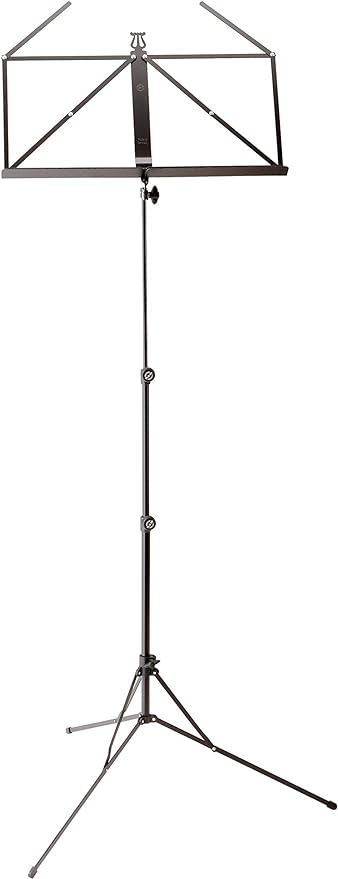
These Konig and Meyers are some of the best stands you can get and, not surprisingly are also best sellers. Your Reviewer has worked in music retail for decades and can count the number of returns for this product, the K&M 101, on one hand. The actual number of sales exceeds the number of fingers on your Reviewers hands by quite a large margin. Polydactyly is not involved. The 3-piece design folds down into a neat, portable box and at around 1kg in weight, it isn’t too heavy. Think of a litre of milk. Doesn’t come with a bag, but you can’t have everything! However, for a price….. Available in black or nickel , or you can have the stand and a matching bag. At the time of writing the stands cost under £25, the bags 7 or 8 quid.