Category: Products

Products reviews

  • Metronomes

    Firstly, let’s get the boring stuff about what a metronome is out of the way. Contrary to what the name may suggest these are NOT very small people living in the darkened tunnels of the London Underground.

    You will all know (I think/guess/hope/imagine) that a metronome is a device used by musicians to keep a consistent tempo during practice or performance. It produces a regulated pulse, often in the form of a ticking sound or a visual cue, to help musicians maintain a steady beat. There are various types of metronomes from mechanical, to digital, software apps.

    Traditional mechanical metronomes are operated by winding up a spring mechanism (rather like an old-fashioned watch or clock) with the tempo set by moving a weight on the pendulum. There is no need for batteries, which is environmentally friendly, but need to be placed on a level surface or they will develop a limp. Some models can be set so that a bell rings on the on the first beat of the bar. You also need to be careful not to overwind the spring as well or it will stop working. A lot of people like the visual help given by seeing the pendulum swing as well. The disadvantage is that they can be bulky, especially the pyramid style ones, and expensive.

    Wittner are, in my opinion, the best traditional clockwork metronomes with the Piccolo models like the Wittner Taktell Piccolo Metronome, which has the advantage over the pyramid shaped ones of being more portable, but if your metronome is going to stay at home, there are some lovely options available.

    Electronic of digital metronomes have the advantage of giving a consistent beat as they are battery operated, and as a result are highly accurate. My favourite is the Seiko SQ-50. It has a dial which you turn to set your tempo and uses traditional metronome timings, and means it is quick to set the tempo and I like that the sound of the beat is of a more analogue style. There is also a red light on the top of the metronome which flashes with the beat. This metronome also gives a A or B-flat tone to tune to if needed, and has a volume control and has a mono 3.5mm stereo mini jack. Reliable and easy to use model. It runs on a 9v battery which is supplied with the metronome.

    Of the digital offerings the Korg MA2 is probably the best out there if you can get past the sound which is very “digital” (for want of a better word). As with the Seiko SQ50 it has a volume control and will give you an A to tune to. The advantage it has over the Seiko is that you can sub-divide the beat which can be useful but sounds completely manic on faster tempos! It uses (and comes with) AAA batteries, which you can probably nick from your tv remote if necessary. This model also has a 3.5 mm stereo mini jack.

    These are the offerings on Amazon, though for the life if me I don’t know how they can get the black/blue combo (my preferred colour choice) rather than black/red as I haven’t been able to get these for years.

    Finally, it is also worth thinking about tuner-metronomes if you also need the combined functionality of a metronome and a tuner. My favourite, by a country mile is the Korg model TM70. The tuning range (c1 to c8) and the metronome range (30 -252) will cater for most requirements, and there is a transpose function which works well for wind and string instruments.

  • D’Addario EFT15

    Acoustic Guitar Strings, flat tops, Phosphor Bronze, Extra Light

    According to the label. they have a warm, semi-bright tone. A semi-flat ultra smooth surface, perfect for slide playing, flat picking and recording, with reduced finger noise.

    Well the last part’s right, the finger noise is reduced from the beginning. First impressions on re-stringing them was that they were very bright. V.V. Bright Indeed. Any brighter and you could use them as fog lamps. But….

    I don’t think I’ve ever had a set of strings settle down quite so quickly. At the start, finger picking seemed to make the strings buzz, flat picking you could hear the noise of the pick on the string over the sound of the note. But I played them for several minutes (John Denvers’ Annies Song if you’re interested – because of the rapid chord changes) gave them their 4th stretch of the day and tried again.

    Now they resemble the blurb.

    They come in a phosphor bronze coloured pack, or as we say in England, Brown, wrapped in a plastic pouch with a number on it that you’re encouraged to enter into the D’Addario website Players Circle rewards program. Join this and you can send your strings back for recycling and gain extra (Brownie?) points. The strings aren’t individually wrapped but they are colour coded on the end of the string you stick in your guitars body. They’re coiled together in pairs, E-A, D-G, B-e. I’m not going to tell you how to restring a guitar; there’s enough tutorials out there to help you, though I’d suggest you learn the very simple Luthiers Knot and find a tutorial that shows you that if you don’t already know it. Also take the opportunity, with the strings off, to clean your guitar thoroughly.

    Give your strings a stretch: over the sound hole (or cone cover on a resonator) hook you’re forefinger under each string and pull up quite hard, the run the forefinger of your other hand from the neck to the highest fret, keeping in contact with the fretboard, 3 or 4 times.

    Retune

    Try to play. Note how you go out of tune very quickly. Repeat the stretch. try to play. About the 3rd time you’ll be able to play for a few minutes and after the 4th for a while longer. Keep your tuner to hand and, for this first day at least, keep stretching the strings. When that doesn’t change the tuning, you can stop stretching.

    Now you’ll also hear the strings as they’ll sound for some time to come. How much time? I’ll come back to this blog and let you know.

    Update

    It’s about 2 months since I strung my guitar with these strings. They’ve been played regularly, every day at home and for about 21 days (not in a row) in one of the most hostile environments known to half naked people – The Beach. 20mph winds, temperatures up to 26c, salt air and sand being blasted everywhere.,

    Despite this the strings maintained their tone and kept their tuning quite well – until this last week before writing this update. This week I’ve had to retune several times a day, and a day means 3 to 4 hours or constant playing. In a less hostile environment they don’t need retuning all that much. The sound has diminished but still isn’t bad. However I wouldn’t want to do a studio session with these strings as they are now.

    One other thing that I’ve noticed was that after a couple of weeks playing bends became radically easier. Although my previous strings were also lightweight it was never really possible to get much more than a half-tone bend, but with these I’ve managed close to, if not actually on, a full tone bend. Blues players might find that noteworthy.

    So, recommended usage.

    These strings will do quite well in a studio environment, especially if your guitar is left there for the whole session. you might want to think about replacing them after about 3 weeks, closer to 2 if you’re going to be doing a lot of overdubs on your previous recordings. You might be able to get 4 weeks out,

    Gigging constantly, maybe 3-4 weeks, depending on what sort of sound you want.

    A professional rehearsing for studio or tours, or maybe song-writing. 5-6 weeks, although you might still be happy with the sound at that point so stick with them until you aren’t. Change them a couple of days before any performance, but I shouldn’t need to tell you that 🙂

    Recreational player? You could get 6 to 9 months, maybe longer.

    Like all things the timings given above are just guidelines. You need to make your own mind up about the condition of your strings and whether you need new ones. The variables are how often and hard you play, how hot or humid it is, what type of music you play, finger or flat picking? I can’t tell you what will happen in your world, only what happened in mine.

    At the time of writing these could be bought for £23.99 with a RRP of £27.90

  • Flute Stands

    Flute stands are essential accessories for flutists. Designed to securely hold and display flutes when they are not in use, a good stand helps prevent damage to the instrument and provide easy access during performances or practice sessions. Before you buy, it’s always worth considering if you just need a single flute stand, or one which can hold a second instrument – most commonly a piccolo, clarinet or an alto flute (if you have one). Look for stands with a sturdy base to prevent tipping: Tripod bases are common and provide good stability.  Ensure the stand has padding or rubberized surfaces at the contact points to protect the flute’s finish from scratches and damage, and if you need to transport the stand frequently, consider foldable or collapsible designs that are easy to carry.

    Stands are typically made from plastic, metal, or wood. Metal stands are durable but heavier, while plastic stands are lightweight but may be less robust.

    Ultimately, the “best” flute stand will depend on your specific needs, such as whether you need it primarily for home, studio use, or frequent travel (the Hercules Travlite is a good choice here). It’s well worth taking time to consider what you want in terms of stability, portability, and overall build quality to make the right choice for your situation.

    My favourites, as usual are Hercules, which are renowned for their stability and durability and K&M whose high-quality stands with adjustable features and robust construction are among the best you will find.

    The Hercules DS640BB is a high-quality single flute stand which has a velvet-covered peg to protect the instrument from scratches. As an alternative the K&M 15232 is a compact and foldable single flute stand with a stable base. The Nomad NIS-C015 is a popular, and reliable, choice for those on a budget.

    If having a stand which fits in your flute case, the Hercules DS460B Travlite stand offers easy to set up and provides a strong, stable base for the instrument. The Compact In-Bell Design allows stand to store safely in the bell of the instrument taking no space in the instrument case, and the velvet on the base of the stand protects the finish of the instrument.

  • Woodwind and Brass Stands

    Woodwind and brass stands are specialized supports designed to hold your instrument securely when they are not being played. Look for good stability and make sure the sections of the stand which come into contact with you instrument are padded in order to avoid damaging your instrument. A good stand will prevent damage to your instrument by holding it securely, offer a safe place to put the instrument during practice, rehearsal or performance when you may need to swap from one instrument to another, and can help maintain the instruments condition by preventing any undue stress on the body of the instrument and the key and valve mechanisms. I also think that, especially for wind and brass instruments, leaving your instrument on a stand helps it dry after use.

    Some of the stands have quite fragile legs, which is why for example, I prefer the K&M 152/3 to the K&M 15232 Compact Flute Stand, but the compact models do fold down to a really small size which can be a consideration when travelling. (Double bass players will snigger at that!)

    If you need stands for multiple instruments, Hercules have some of the best offerings on the market.

  • Cello & Double Bass Stands

    Cello and double bass stands are essential for safely storing and displaying these larger string instruments when they’re not in use. Although there are wall hangers available, I’ve never really found a satisfactory one – I think the instruments are simply too big in the body – and would always go for a sturdy floor stand. Both K&M and Hercules have good offeringss in the mid-to-high price range. While they may be more expensive than some basic models, in each case the quality, durability, and features more than justify the investment. For me, they offer excellent value for money, especially for serious musicians who need a reliable stand.

    The K&M 141/1 Cello Stand is renowned for its quality and durability, making it a popular choice among cellists. This stand is constructed with high-quality materials, featuring a sturdy metal frame, wide base, rubberise supports, and a cushioned backrest to ensure the cello is securely held without any risk of damage or scratches. The stand’s build quality is robust, providing long-lasting durability. I also like the adjustable arms which means it will hold various sizes of cello securely

    Cello Stands

    It is also relatively lightweight and foldable, which makes it reasonably portable (and lets’ face it cellos are bulky enough to carry round, especially on public transport, so every little helps), allowing cellists to transport it easily to rehearsals, performances, or lessons. The compact folding design is also is convenient to store when not in use.

    Despite its solid construction, the Hercules DS580B is relatively lightweight and foldable, making it easy to transport. It folds down to a compact size, which is convenient for storage and travel.

    Stability is a key feature of the Hercules DS580B stand. It boasts a wide base with non-slip rubber feet that prevent it from slipping on various surfaces.

    The stand has a sleek and modern appearance with a clean design that fits well in various environments, from home studios to concert stages.

    As a budget option this Cobra stand seems quite good, but I haven’t had enough experience of this stand to fully assess it. However, at £32.95, a 4.4 star rating on Amazon, and coming with a 2-year warranty it seems to be a decent offering for the price.

    Double Bass Stands

    For double bass players, the K&M 141 model Double Bass Stand is a sturdy (vital with such a large instrument) and adjustable floor stand. The soft rubber covered adjusting arms will hold you bass securely. Pretty much the best stand out there for basses in my opinion.

    The Hercules offering is the Hercules DS590B. As with all Hercules stands, it has a good solid construction, but lacks a bow holder and a neck brace, which I think is a disadvantage, especially on such a large and expensive instrument.

  • Keyboard Stands

    When selecting a keyboard stand, it’s worth taking some time to consider the following factors:

    How much does your keyboard weigh and will the stand you are considering support the weight of your keyboard. You will need a more stable stand such as a Z style or table-style stand if you have a heavy keyboard stand or a have a rigorous playing style. Also check the adjustability of the height and width to make sure you can get a comfortable playing position.

    If you need to transport the stand frequently for gigging, look at good lightweight and foldable stands. Additionally, some stands come with additional tiers or racks for extra equipment.

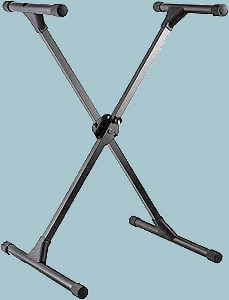
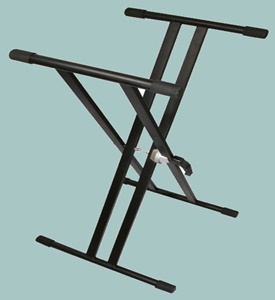
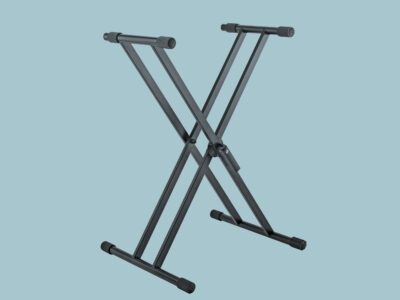
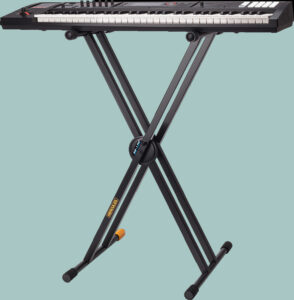
    X-Style Stands have an “X” shape and are one of the most common types due to their affordability and portability. These tend to be lightweight and easy to fold and transport. The downside is that they may not be as stable for heavier keyboards and can have limited adjustability in width (there are usually only 4 settings). They stands can be single or double brace (i.e double X), with the double brace style stands giving better stability. The biggest drawback with X style stands is playing your keyboard in the seated position. As soon as you sit down, it’s hard to position yourself without knocking your knees into the brace, which in true domino style can result in the keyboard getting knocked off the stand.

    Our choice for single X style stands are:

    And for double brace stands, which are more solid than single brace ones, the following are good options:

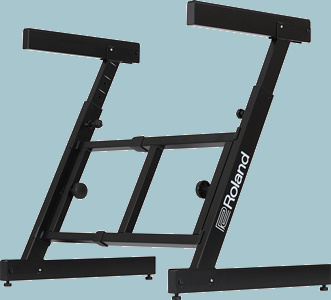
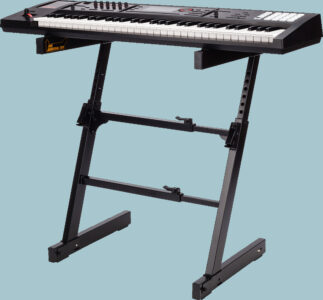
    Z-Style Stands have a “Z” shape, providing better stability and more surface area for the keyboard. They tend to be more stable that the X style stands and can support heavier keyboards. This does make them heavier and bulkier to transport. I like the Roland KS 11Z and the Hercules KS400B. Neither are cheap, but they give good support to your (possibly quite expensive) keyboard.

    The Roland KS 11Z is one of the best around – a really solid stand at 10 kg. The KS-11Z provides a robust and stable platform which can handle portable keyboards and pianos with up to 88 keys and weighing up to 100kg. There are multiple adjustment points which allows you to tailor the width and height to your keyboard: There is a quick release lever for the width adjustment of between 566mm and 940mm and a spring-loaded for the height adjustment of 645mm to 917mm. The adjustable feet give good stability on uneven floors and the support arms a padded and fold down for transport and storage. The arms also quickly lock into place when putting the stand up. An impressive stand.

    The Hercules KS-400B Z-Stand Keyboard Stand has a built-in AutoLock System which allows you to set the desired height by simply raising the arms with height parameters of 604.5mm to 929.6mm and you can adjust the width between 508mm and 851mm. There are fluorescent marks to allow you to adjust both arms evenly which is useful when on a dark or dimly lit stage.  The locking pins give a quick and secure set up and adjustable feet give a good stable setup. Weighing in at 8kg, it has an impressive load capacity of 127.9kg

    Of the more affordable options, Rockjam has a pretty good offering.

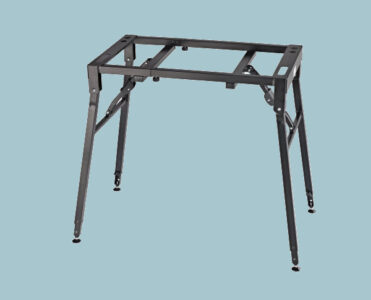
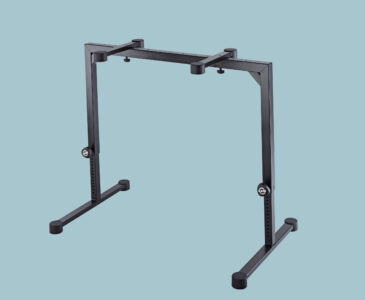
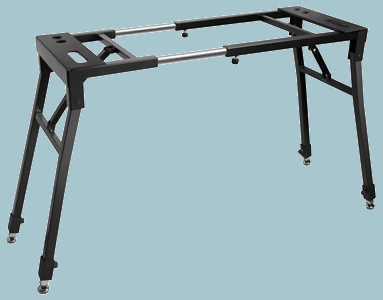
    Table-Style Stands resemble a small table and often come with additional features like racks for gear. They are very stable, offer height adjustability and can hold additional equipment, but they tend to be very heavy (i.e. not as portable) and more expensive than other stands.

    A couple of the K&M models are our best picks if you need a quality, robust stand, but TGI do a good offering as well.

    The K&M 18950 is a high quality, steel-made table style keyboard stand. Because the legs can be individually adjusted and each leg has levelling feet, and non-slip rubber pads, it is a very stable stand. The height adjustment is from 600mm to 1,000 mm, and can take a second keyboard if needed. Weighing in at 10.7 kg it has a maximum load capacity is 80kg. As you can see here, it folds down really neatly as well.

    km517FKOhgQL. AC SL1162 1 e1727285186692

    The other K&M offering I quite like is Omega 18810. It’s very stable and robust keyboard stand (9.2kg) which has a spring-loaded height adjustment and is quick to assemble The support depth is 345mm, width is from 180mm to 790mm and the height ranges from 600mm to 1020 mm. You can also bolt on a range of attachments such as ipad and tablet holder, mic stands and even has 4 velcro tapes for cable management. All in all, quite an impressive offering.

    If you don’t want to spend quite so much, the TGKT1 stand is pretty good as well. Weighing in at just under 9kg, it’s quite solid, and will support up to 80kg, giving it the same capacity as the K&M 18950. The height range is 620mm – 790mm, the width is 710mm – 1020mm, and the depth is 320mm.

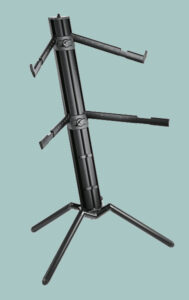
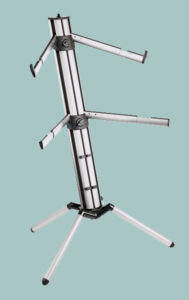
    Column Stands have a central column with arms extending out to hold the keyboard. These stands offer good stability and often have multiple tiers for multiple keyboards. The design of these can be quite sleek, but they are often not as adjustable as other keyboard stands and can be bulky. If you are looking at these stands you are prepared to spend (they tend to be quite expensive) so I would just go for the best on the market which in my opinion is the K&M 18860 Spider Pro. There is no Hercules offering for this style of stand, The Spider Pro is an aluminium made stand has a tripod base with adjustable legs. This stand has an innovative double tiered design with arms coming out of a wide vertical spine of the stand with tripod base. The upper arms can also be moved to a 15 degree angle which allows easier access to the keyboard on the lower arms. You can also add additional support arms and attach a third keyboard. You can also attach microphone booms. It weighs 10.8 kg and the arms have weight capacity of 35kg per level. Extra arms and a carrying case can be purchased separately. 

  • Clarinet Stands

    Before you buy, it’s worth considering if you just need a single clarinet stand, or are you going to need a stand which holds another instrument, such as a flute, as well. Either way, you will need a stable stand which has a good solid base or a tripod design. Padded pegs for the instrument to sit on are a good idea, as this prevents your instrument getting scratched. Make sure your stand fits inside your instruments case of gig bag if you frequently travel with your instrument.   

    Hercules Stands and K&M both have high quality offerings and are about the best available.

    Known for their robust construction and innovative designs, the Hercules DS640BB clarinet stand is a solid, heavy-duty stand, and has a velvet covered peg. It comes with a bag, which is handy because it probably won’t fit in your case. König & Meyer offer high-quality stands with excellent stability and durability. The K&M 15228 Pavilion stand is well-regarded for its foldable design and gives good stability from the 5 metal legs. It can also be stored insdie the bell of the clarinet which gives good portability. If price is an issue the Nomad NIS-C043 stand is an excellent choice; the folding design collapses quickly, but isn’t quite as stable or robust as the Hercules or K&M models mentioned above.

    If you want a really compact stand, the Hercules DS440B clarinet stand is a good option as it fits inside the bell of the clarinet. Alternatively, the K&M 15222 Compact Clarinet Stand is a good quality stand 4 leg stand which is small enough to fit in most cases.

  • Instrument Stands

    As with everything musical, there is a huge range to choose from. I always prefer to stay away from super cheap stands. Your instrument can be worth a lot of money, so why skimp on the stand and risk damage? After all, it’s better to spend a little bit of money on a stand rather than putting it down on a chair and sitting on it – anyone who has done this will never forget the sound of a shattering instrument. A good stand will also be designed to keep your instrument in good condition by avoiding improper storage. In a more professional situation, it’s easier to manage the use of multiple instruments if good, well designed stands are used, and in a domestic situation you’re more likely to play your instrument if you can see it – tucked away in a bag in the corner makes it easy to ignore!

    My favourite instrument stand brands are Konig & Meyer (which come with 5 year guarantees) and Hercules. Both these brands, which in my many years in retail, have very, very low rates of returns, with TGI and Nomad giving good cheaper options.

    Click on the links below to see our reviews on stands for your instrument.

    Compare

    • Guitar
    • Clarinet
    • Woodwind & Brass
    • Cello & Double Bass
    • Violin & Viola
    • Flute
    • Keyboards
  • Guitar Stands

    Our favourite guitar stand supplier is Hercules. Originator of the auto-grab system, which is so convenient, these are good robust stands. Personally, I prefer stands which hold the neck (vital if you have children and dogs running around), but there are good A frames stands of you are short of space, or just want something compact. Wall hangers are a good choice, especially if you are short of floor space, but be careful not to position them above radiators or on outside walls.

    This portable K&M A-frame guitar stand is suitable for acoustic, electric, and bass guitars. There is a push button system that enables adjustment for different types of guitars. This stand folds flat for easy transport and can also be used with guitars which have a nitrocellulose finish. As usual for K&M, this comes with K&M standard 5-year guarantee. Make sure you pick the correct one to hold your guitar (electric guitars are much thinner than classical and acoustic ones), but this model will work for all types.

    This Hercules guitar stand also fits acoustic and electric guitars has hard rubber contacts and a special formulated foam which protects your guitar from scratches. Very compact design which will fit most gig bags as well. The design fits both acoustic and electric instruments and folds down enough to fit in gig bags. Very light weight at just 0.5kg.

    Hercules guitar wall hangers are a great option, especially if you need to keep your guitars off the floor (you know – kids, pets, or just being a bit of a klutz). The have the Hercules Auto Grip System and we have used the slatwall version of these successfully for years. For home use the wood finishes are aesthetically pleasing. The grip mechanism itself uses specially formulated foam rubber fully protects your guitar and will take up to 7kg in weight.

    For Multi-Guitar stands the K&M and Hercules are excellent choices.

  • Admira Guitars

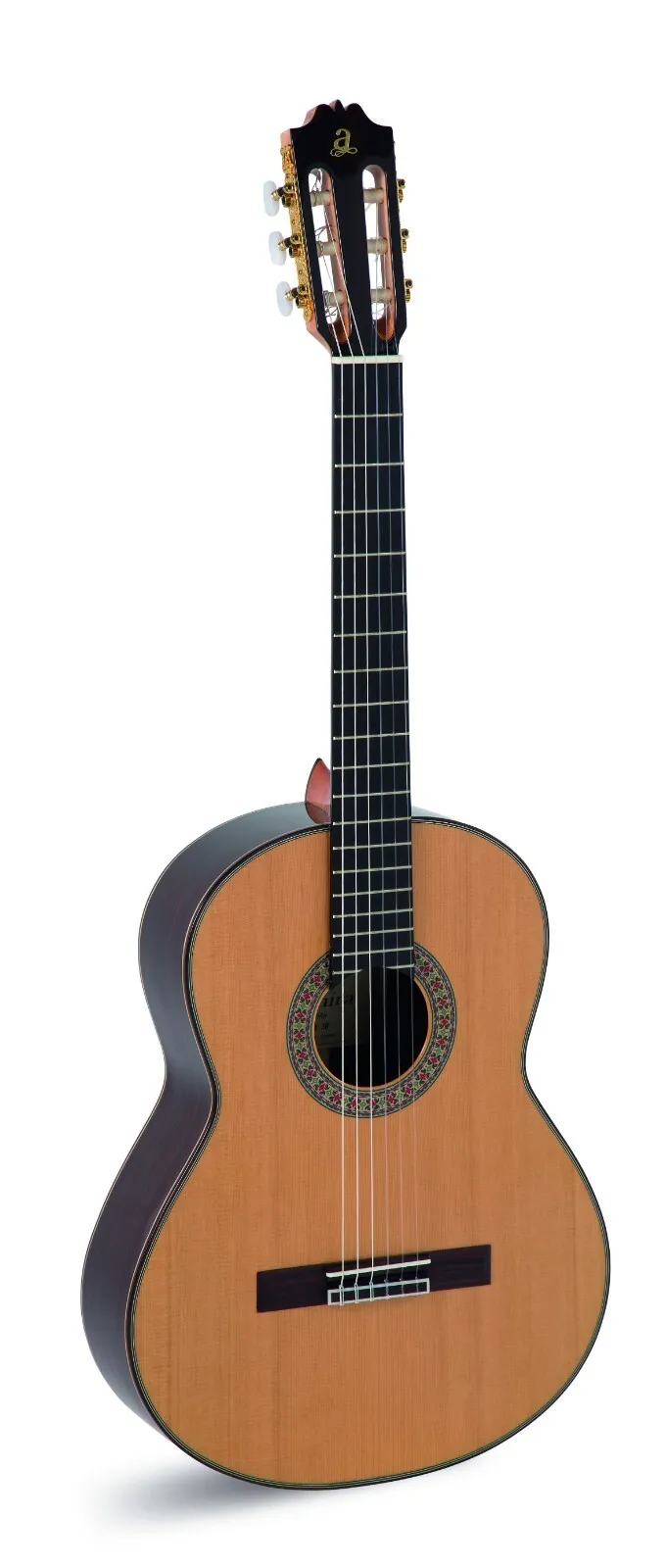
    Admira Guitars

    Admira Label

    He looked at me and said “You’re using harmonics?” I nodded. “I never thought of that. I’ve had it a few years and still can’t play. Take it, it’s yours”. That’s how I came to have a classical guitar that’s been in my possession for the last 30 odd years. It was an Admira and I found out a bit later that it would have cost him around £300.

    Recently I had the opportunity to play the latest model in that series and was excited to see if it had changed in anyway or had the same quality as mine

    If we start with the construction of mine, it’s made with the following materials

    • Top: Solid Cedar with a Satin finish.
    • Sides and Back: Rosewood with a Satin finish. Some listings mention Ovangkol, which is very similar to Rosewood in its tonal properties.
    • Neck: African Mahogany.
    • Fretboard: Mahogany.
    • Bridge: Mahogany.
    • Machine Heads: Nickel Lyre.

    These materials are chosen for their durability and contribution to the guitar’s tone and resonance. The combination of solid cedar and rosewood or ovangkol is typical for classical guitars, providing a warm, rich sound with ample volume and clarity. And 30 years later that’s still the case. It’s a beautiful instrument to play.

    But how does it compare to the A20 latest version?

    Well the construction materials are almost identical. The only difference is the newer model has an ebony fretboard and the whole thing costs more more than 4 times as much as the 1980s model at £1,290 on Amazon. That’s probably a great bargain considering how prices have risen in 30 years (a 50p pint of beer will now cost you £5.70). The sound though, well seriously it’s well named. You could pay £4,000 or more for a similar sounding guitar. It’s a joy to play. Your fingers just seem to find the right frets as if by magic, the tone can only be described as amazing and when you need to move your left hand rapidly from 1st to 3rd position your thumb slides up the neck as if it were oiled but never feels slippery. When you stop you feel secure in whatever position on the neck you happen to be. Harmonics just ring out loud and clear.

    If you want an instrument for fairly frequent performances but you don’t get paid top whack (yet), well this one will be a good investment.

    But what if you don’t have a spare £1,300 lying around or maybe you’re just starting out in classical guitar playing? Well first lets look a little at the company and ethos.

    Admira guitars are crafted with a blend of traditional Spanish guitar-making techniques and modern manufacturing systems. The process involves:The manufacturing workshops are based in Zarautz, northern Spain, where the guitars are produced to maintain the highest quality. The dedication to craftsmanship at Admira ensures that each guitar upholds the rich tradition of Spanish guitar making while incorporating modern elements for today’s musicians.

    • Selecting Woods: Admira guitars often use solid cedar for the top and Indian rosewood or mahogany for the back and sides, which are known for their tonal qualities and durability.
    • Handcrafting: While some processes are automated, the vast majority of each guitar is built and finished by hand by skilled craftsmen and women.
    • Neck Construction: The neck is typically made of mahogany with rosewood reinforcement, enhancing the instrument’s sturdiness and attractiveness.
    • Bridge: A rosewood bridge is used, aiding resonance, intonation, and tone.
    • Spanish Heel: The ARTESANÍA series, for example, is made with the union between the body and the neck of the guitar through the Spanish heel, a traditional method of construction.

    The manufacturing workshops are based in Zarautz, northern Spain, where the guitars are produced to maintain the highest quality. The dedication to craftsmanship at Admira ensures that each guitar upholds the rich tradition of Spanish guitar making while incorporating modern elements for today’s musicians.

    This applies pretty much to every guitar they make, no matter what the cost and they start at £123 for a full size guitar. It’s the Alba Student guitar. In this case, though, the word Student doesn’t apply to the musician but to the craftsperson who made it, under supervision of one of Admiras’ master luthiers. A rosewood back, sapele sides, pine top, mahogany neck means it[‘s suitable for a beginner

    Next up is the Malaga, made from spruce, mahogany and rosewood. This is a solid top guitar and you will be very hard pressed to find one of this quality and craftsmanship for £258. You’d probably get one of these, or the Concerto, when going for your grade 4 exams.

    Of course you could splash out a bit more and get the Concerto model. A cedar top and rosewood back. cedar body and mahogany neck give this guitar one of the best sounds at this price . £279

    But now we’re going to skip a few models and head to the £400 mark (£402 on the day of writing) with the A4. This instrument has a mahogany back and sides with a cedar top, mahogany with ebony reinforcements for the neck and kabakulli for the fretboard. `The neck joint is with the Spanish Heel technique, considered the most highly developed technique for this area. At this price range you’re getting serious about your guitar playing and this is an instrument that will back you all the way. an excellent sound. You just won’t get a much better guitar at this price. You’re also unlikely to get one that’s all solid wood, and it will last.

    Our last look on this visit was at the A45. This model is part of Admira’s ARTESANÍA series, which is crafted by skilled luthiers using traditional handcrafting methods to produce guitars with exceptional tone, clarity, and expression. This series represents the crown jewel of Admira’s offerings, blending top-quality materials with passionate craftsmanship. You can guess that just as the materials are superior, so is the tone and the sheer playability of this guitar. If you’re doing your B. Mus. and focussing on classical guitar this model would be up there on my list of ones to buy. £649 at the time of writing

    Disclaimer: Admira didn’t pay us, or ask us to write this review. We just happen to be very impressed by their guitars. But if you do buy from Amazon we’ll get a small commission.

The Music Realm
Privacy Overview

This website uses cookies so that we can provide you with the best user experience possible. Cookie information is stored in your browser and performs functions such as recognising you when you return to our website and helping our team to understand which sections of the website you find most interesting and useful.