Author: Rob

  • The Elephant

    Whether we like it or not, the double bass will be for ever linked with the large, lumbering and lugubrious elephant – much as the cello is with the elegant swan, or the tuba with Tubby!                                                                                                    

    It wasn’t always the case however, and certainly in the 18th-century the double bass was an important and respected solo instrument with a vast repertoire of concertos and solo works by Dittersdorf, Vanhal, Hoffmeister, Pichl, Kohaut, Mozart, Koželuch, Sperger, Zimmerman and Haydn. In the 19th-century Giovanni Bottesini (1821-1889) was able to dispel the myth that the double bass was only an orchestral or bass-line instrument, and one report noted that his bass sounded like a ‘cage full of nightingales’.

    From 1886, the year of its composition, and 1922, the year of publication, the image of the double bass was changed for ever. The Carnival of the Animals by Camille Saint-Saëns (1835-1921), a perennial favourite at children’s concerts, represented the double bass in a humorous ‘pomposo’ way and we are now blessed with our own ‘national anthem’. The Carnival of the Animals is one of Saint-Saëns’ most popular works and it is perhaps ironic that, in a career lasting almost seventy years and having composed operas, concertos, symphonies, choral works and chamber music, he should be best remembered for a work that was only written as a musical relaxation.

    Saint-Saëns’ misgivings about the popularity of The Carnival of the Animals overshadowing his many other great achievements was entirely accurate, and it was not released for publication until after his death in 1921. The complete work was published the following year, just over thirty-five years after its composition, and The Elephant was released into the musical community. It is a rare work of musical humour which never fails to thrill its audience, young or old.

    The Elephant exists in a variety of editions, was used as background music for a series of television adverts for a well-known UK superstore, and inspired the ever-popular The Elephant’s Gavotte by New York bassist, David Walter. One other enduring image is of an almost endless line of bassists standing along the promenade in Port Erin, performing The Elephant during the 1978 Isle of Man Double Bass Competition & Festival. Director, John Bethell, astride a large inflatable elephant, conducted the assemble bassists as Clifford Lee manfully provided the accompaniment on a piano which had been dragged across the beach. This was an excellent publicity opportunity, recorded by the BBC, and what else could they play?

    The Elephant is the fifth movement of The Carnival of the Animals and, although only 52 bars long and lasting a little over a minute, it has really captured the imagination of the concert-going public. In E flat major and in 3/8 time, it remains in the lower orchestral register for much of the time and is a musical joke par excellence. Saint-Saëns created a work of great invention and imagination, whether we like it or not, and he has imbued the work with great skill and humour which is typical of the suite as a whole.

    The Elephant begins in a grand and heroic style, with a strong four-bar chordal introduction, although bars two and four lack a downbeat, which is one thing a waltz-inspired piece needs above all things, and the double bass is ‘wrong-footed’ immediately with an upbeat theme which begins on the first beat of the bar. Extracts from Berlioz’s Danse des Sylphes (The Damnation of Faust) and Mendelssohn’s Scherzo from A Midsummer Night’s Dream, adapted in an elephantine style and several octaves lower than the original, are used to offer the double bass and opportunity to dance elegantly.

    The original music returns, but now with a light harp-like accompaniment, and little by little the two instruments come together until they play in unison followed by a two-bar scalic-run from the lowest register of the double bass, offering one brief pirouette for the heroic pachyderm, before a two-bar coda confidently states “That’s All!” with its final two chords.

    The music is witty and cleverly written to describe the elephant and is a minor musical masterpiece. It is probably the first piece to introduce the double bass to a general audience and, although the double is so much more than this one piece, we all embrace it to the present day and I can guarantee that every bassist will have played it at least once in their musical career.

    David Heyes
    D’Addario Performing Artist
    16 October 2024

  • When I Grow Up I want to Be a …

    What did you want to be when you grow up? Amazingly, at the age of about 16 or 17 I wanted to be a publisher with a company specialising in music for the double bass, and do you know what? I achieved my dream and in two years time Recital Music will be 40 years old.

    I started playing the double bass at school at the age of 14, when all music lessons were free, and my passion for our repertoire and the composers who wrote for us, quickly took hold and hasn’t changed in all that time. Yorke Edition, founded in 1969 by Rodney Slatford, published music for double bass and I played many of their pieces for the ABRSM grade exams; I read about American bassist Bert Turetzky and his pioneering work to encourage contemporary composers to write for the instrument, and my second teacher, Laurence Gray, told me about the Paris Conservatoire and their decades long project to commission one new double bass piece to be performed by the graduating bassists in their final recital. All these influences played their part in my plan.

    Magazines from the USA-based International Society of Bassists opened up a world of possibilities for me and in 1986, having just returned from studying in Prague with František Pošta, Recital Music was started with two salon pieces for double bass and piano by Vojta Kuchynka (1871-1942), which I had brought back with me from Prague and were not available in the West and they remain in our catalogue to this day.

    38 years later, Recital Music has now moved to digital editions, encouraged by the changing music business and musical world, and we have the largest catalogue of double bass music in the world. We publish music for every ability level, from complete beginner to virtuoso and from one bass to twenty, including music from the 15th-century to this year. Many significant double bass composers of our day are featured in our catalogue, alongside composers from the past, and we publish a wealth of transcriptions of all styles and idioms.

    Having bought and played many of the double bass pieces on the ABRSM grade lists in the 1970s, Recital Music is now the largest independent publisher on the grade lists of both the ABRSM and Trinity College (London), and my name is also  there as a composer, editor and arranger. 

    The journey from my dream of starting a publishing company to now has been eventful and exciting but I wouldn’t have changed one minute of it. How lucky am I? Even as a schoolboy I knew I wanted to be a professional double bassist and start a publishing company and I achieved both dreams and far more than I could have imagined. Dare to dream and it’s amazing what you can achieve if you have belief and a little bit of luck!

    David Heyes
    D’Addario Performing Artist and Founder of Recital Music, (probably the best collection of Double Bass music on the planet)

  • (Near) Silence Is Golden

    As double bassists we have many pieces of equipment which are essential – the obvious ones are a bass, bow, rosin and case. Alongside these are other things which we use such as a tuner, a duster to clean the rosin off the strings, a mute and one of the most important things, which can be as rare as hens teeth in many bass sections – a pencil.

    Double Bass Wheel

    Double Bass Wheels

    We need something to transport the bass, such as a wheel or carrying strap and many other useful tools and gadgets, but one of the most useful things I have ever bought for my double bass is a practice mute. Not one of the smaller mutes which conductors insist on, even though they don’t always make much difference, but one of the hefty plastic or rubber mutes with five prongs.

    A practice mute fits across the entire bridge and really does deaden the sound. Sometimes I even add a duster or two across the bridge to soak up a few more of the vibrations.

    Double Bass Mute

    Double Bass Mutes and Accessories

    Why do I think a practice mute is so important?

    There are many reasons but it’s mainly to keep everyone in your house, and your neighbours, happy! Obviously, I realise how lucky they are to witness the wondrous tones of a double bass but sometimes even our nearest and dearest are immune to the instrument’s many charms. A practice mute allows us to ‘belt out’ whatever we are playing, but minus many of the usual decibels that we all love and cherish.

    One other benefit of a practice mute is to help develop a strong tone when it is employed, and then to hear and feel the difference when it is removed and the bridge is allowed to resonate freely. Suddenly you can feel the true power of your sound, which has been helped by using the practice mute, much like an athlete who uses resistance workouts to increase speed and agility.

    Which practice mute to buy? There are many to choose from and my mute is probably decades old, almost like new, and to me is worth its weight in gold. They are quite inexpensive, so it isn’t a big investment financially, but professionally it’s worth a fortune. Give it a go….

    David Heyes
    D’Addario Performing Artist
    4 September 2024

  • Which Bass Rosin Should I Buy?

    Not a problem, I’ll look online – BUT: suddenly I am faced with dozens and dozens of different rosins, so which is the right one for me?

    There are so many factors to take into account. If you are an orchestral player, you will probably need one of the stronger rosins but if you are a beginner, maybe a more general rosin might be better. Baroque players need something different again, some soloists prefer violin rosin, so where do I start?

    Do you live in a hot or cold country? That will determine which rosins are most suitable for your climate, and possibly which ones to avoid.

    There are so many questions but also a similar number of answers. Over the years I have used rosins by Hidersine, Eugene Cruft, Pops, Carlsson, Nyman and Leatherwood Bespoke, maybe even more, and at the time the one I was using was my favourite. For many, many years I used Nyman’s rosin, which most of my students also liked, and which seemed ideal for the British climate, apart from the hottest spells when many a bass or bow case has been covered in a sticky rosin residue, which seems to glue everything together for weeks, but overall, it was good for all my playing needs – solo, chamber music and the occasional orchestral date.

    A few years ago everyone was raving about the new Leatherwood Bespoke rosin (the amber range), which seemed inordinately expensive, but many friends from around the world raved about the rosin, so I ordered two pots from Australia and settled on 20% and 25%, because I do more solo than orchestral playing nowadays, and waited for the post to arrive. It duly did and I absolutely fell in love with the 25% which produced a clear tone across all the registers and suited my bass and strings perfectly. I now only use Leatherwood and love everything about the rosin and am about to order two new pots, although I see they no longer produce a 25% mix so I’ll buy a 20% and 30% and use one swipe from each to hopefully create something like a 25% rosin which I like.

    Which rosin is best for you? There are so many different ones to choose from, alongside different string types, playing styles and temperatures, and my advice would be to ask your teacher, a friend or colleague, who will give you good advice from a local perspective, or read some of the online reviews (like this one 😊) and take a chance that it’s the right one for you. Rosin, on the whole, is inexpensive so it isn’t such a big investment if you don’t like the one you have bought.

    Personal recommendation is a good starting point and my first pot of rosin was at the back of a cupboard in our music department at school alongside a hardback copy of the Simandl Method, and that’s how I started. I can’t remember which rosin it was but it would have been old, I am certain of that, but other bassists and teachers were happy to help with suggesting different rosins and I never looked back. I know what I like, I know what I don’t like, but there is something out there for everyone.

    Happy rosin hunting.

    David Heyes
    D’Addario Performing Artist
    4 September 2024

  • Metronomes

    Firstly, let’s get the boring stuff about what a metronome is out of the way. Contrary to what the name may suggest these are NOT very small people living in the darkened tunnels of the London Underground.

    You will all know (I think/guess/hope/imagine) that a metronome is a device used by musicians to keep a consistent tempo during practice or performance. It produces a regulated pulse, often in the form of a ticking sound or a visual cue, to help musicians maintain a steady beat. There are various types of metronomes from mechanical, to digital, software apps.

    Traditional mechanical metronomes are operated by winding up a spring mechanism (rather like an old-fashioned watch or clock) with the tempo set by moving a weight on the pendulum. There is no need for batteries, which is environmentally friendly, but need to be placed on a level surface or they will develop a limp. Some models can be set so that a bell rings on the on the first beat of the bar. You also need to be careful not to overwind the spring as well or it will stop working. A lot of people like the visual help given by seeing the pendulum swing as well. The disadvantage is that they can be bulky, especially the pyramid style ones, and expensive.

    Wittner are, in my opinion, the best traditional clockwork metronomes with the Piccolo models like the Wittner Taktell Piccolo Metronome, which has the advantage over the pyramid shaped ones of being more portable, but if your metronome is going to stay at home, there are some lovely options available.

    Electronic of digital metronomes have the advantage of giving a consistent beat as they are battery operated, and as a result are highly accurate. My favourite is the Seiko SQ-50. It has a dial which you turn to set your tempo and uses traditional metronome timings, and means it is quick to set the tempo and I like that the sound of the beat is of a more analogue style. There is also a red light on the top of the metronome which flashes with the beat. This metronome also gives a A or B-flat tone to tune to if needed, and has a volume control and has a mono 3.5mm stereo mini jack. Reliable and easy to use model. It runs on a 9v battery which is supplied with the metronome.

    Of the digital offerings the Korg MA2 is probably the best out there if you can get past the sound which is very “digital” (for want of a better word). As with the Seiko SQ50 it has a volume control and will give you an A to tune to. The advantage it has over the Seiko is that you can sub-divide the beat which can be useful but sounds completely manic on faster tempos! It uses (and comes with) AAA batteries, which you can probably nick from your tv remote if necessary. This model also has a 3.5 mm stereo mini jack.

    These are the offerings on Amazon, though for the life if me I don’t know how they can get the black/blue combo (my preferred colour choice) rather than black/red as I haven’t been able to get these for years.

    Finally, it is also worth thinking about tuner-metronomes if you also need the combined functionality of a metronome and a tuner. My favourite, by a country mile is the Korg model TM70. The tuning range (c1 to c8) and the metronome range (30 -252) will cater for most requirements, and there is a transpose function which works well for wind and string instruments.

  • D’Addario EFT15

    Acoustic Guitar Strings, flat tops, Phosphor Bronze, Extra Light

    According to the label. they have a warm, semi-bright tone. A semi-flat ultra smooth surface, perfect for slide playing, flat picking and recording, with reduced finger noise.

    Well the last part’s right, the finger noise is reduced from the beginning. First impressions on re-stringing them was that they were very bright. V.V. Bright Indeed. Any brighter and you could use them as fog lamps. But….

    I don’t think I’ve ever had a set of strings settle down quite so quickly. At the start, finger picking seemed to make the strings buzz, flat picking you could hear the noise of the pick on the string over the sound of the note. But I played them for several minutes (John Denvers’ Annies Song if you’re interested – because of the rapid chord changes) gave them their 4th stretch of the day and tried again.

    Now they resemble the blurb.

    They come in a phosphor bronze coloured pack, or as we say in England, Brown, wrapped in a plastic pouch with a number on it that you’re encouraged to enter into the D’Addario website Players Circle rewards program. Join this and you can send your strings back for recycling and gain extra (Brownie?) points. The strings aren’t individually wrapped but they are colour coded on the end of the string you stick in your guitars body. They’re coiled together in pairs, E-A, D-G, B-e. I’m not going to tell you how to restring a guitar; there’s enough tutorials out there to help you, though I’d suggest you learn the very simple Luthiers Knot and find a tutorial that shows you that if you don’t already know it. Also take the opportunity, with the strings off, to clean your guitar thoroughly.

    Give your strings a stretch: over the sound hole (or cone cover on a resonator) hook you’re forefinger under each string and pull up quite hard, the run the forefinger of your other hand from the neck to the highest fret, keeping in contact with the fretboard, 3 or 4 times.

    Retune

    Try to play. Note how you go out of tune very quickly. Repeat the stretch. try to play. About the 3rd time you’ll be able to play for a few minutes and after the 4th for a while longer. Keep your tuner to hand and, for this first day at least, keep stretching the strings. When that doesn’t change the tuning, you can stop stretching.

    Now you’ll also hear the strings as they’ll sound for some time to come. How much time? I’ll come back to this blog and let you know.

    Update

    It’s about 2 months since I strung my guitar with these strings. They’ve been played regularly, every day at home and for about 21 days (not in a row) in one of the most hostile environments known to half naked people – The Beach. 20mph winds, temperatures up to 26c, salt air and sand being blasted everywhere.,

    Despite this the strings maintained their tone and kept their tuning quite well – until this last week before writing this update. This week I’ve had to retune several times a day, and a day means 3 to 4 hours or constant playing. In a less hostile environment they don’t need retuning all that much. The sound has diminished but still isn’t bad. However I wouldn’t want to do a studio session with these strings as they are now.

    One other thing that I’ve noticed was that after a couple of weeks playing bends became radically easier. Although my previous strings were also lightweight it was never really possible to get much more than a half-tone bend, but with these I’ve managed close to, if not actually on, a full tone bend. Blues players might find that noteworthy.

    So, recommended usage.

    These strings will do quite well in a studio environment, especially if your guitar is left there for the whole session. you might want to think about replacing them after about 3 weeks, closer to 2 if you’re going to be doing a lot of overdubs on your previous recordings. You might be able to get 4 weeks out,

    Gigging constantly, maybe 3-4 weeks, depending on what sort of sound you want.

    A professional rehearsing for studio or tours, or maybe song-writing. 5-6 weeks, although you might still be happy with the sound at that point so stick with them until you aren’t. Change them a couple of days before any performance, but I shouldn’t need to tell you that 🙂

    Recreational player? You could get 6 to 9 months, maybe longer.

    Like all things the timings given above are just guidelines. You need to make your own mind up about the condition of your strings and whether you need new ones. The variables are how often and hard you play, how hot or humid it is, what type of music you play, finger or flat picking? I can’t tell you what will happen in your world, only what happened in mine.

    At the time of writing these could be bought for £23.99 with a RRP of £27.90

  • It’s All About the Performance, Stupid!

    It’s All About the Performance, Stupid!

    Look, I know you might find that title offensive, but it’s not all about you. In fact in this case it’s not even about you. But it is about me. OK….. it might be about you as well. It depends if you’re going through what I went through when I started learning music. learning to play the piano.

    There are, broadly speaking, two types of people in the world, the Show-offs and the !Show-offs. The ! before the word means “Not”. You’ll see this a lot in Maths and programming, as in if( ! is_product() ) return $content; meaning if it isn’t a product show the content field. You probably had/have one in your class, always playing around hoping to distract everyone from the fact that he hasn’t a clue but also stopping you finding out what you want to know. And then there’s you. Whilst not a shrinking violet you don’t really want to come forward and take the spotlight.

    And you’re learning to play a musical instrument.

    Welcome to the select club of people who actually decided to do something about making musing instead of just listening to (and criticising) those who do make it.

    You know, I used to wonder why so many pianists I’d watch on TV used to sit hunched over, then start moving their bodies about, and lifting their arms up high before gently touching down on the keys. Couldn’t possibly make any difference could it? I mean, you push the key down, the hammer is triggered and strikes the strings. How much control do you have there? I’ve been playing some Beethoven recently where I’m trying to make the last note of a piano sonata movement so quiet a listener might think I’d not played the note at all. Just a hint of a sound. I found the only way I could really do that was theatrically. Even if there’s no-one else to hear I find I’m still putting on a performance, and that is the essence of playing music.

    Another post on this site notes that the Japanese have a 3 word concept of the learning process – Shu, Ha, Ri. Learn by copying. Adapt to your personality and physique. Reinvent the wheel, by which I mean create a new type of music.

    How often has a teacher told you to pay attention to the phrasing? Because it’s the phrasing that’s going to help you perform the piece. When my teachers were saying that to me I just didn’t get it. What I was reading on the page didn’t make any sense to me. Over the years I grew to understand the concept of phrasing but still what I was reading just didn’t work for me, and one day I realised that what I was reading was just Someone Else’s Idea of how the music should sound. I didn’t have to like it. I tried it out in a grade exam (probably not the smartest move to make) on a piece where I really didn’t like either the dynamics or the phrasing. The examiner asked my why I didn’t play the dynamics as scored. I replied that I thought they sounded wrong that way.

    That performance got me the best marks of the three pieces I played that day.

    Now I don’t have a teacher and I can play anything the way I like and want to play, can try different things out and see how they work. Maybe I want to play something by a band that had 5 guitarists and 4 singers, and there’s just me and my ol’ six-string (but not the one from the 5-&-Dime – I broke that some years ago. See the post on Instrument Stands for the reason). I can’t sound like there’s 5 of me on guitar, and the best multiple personality in the world still can’t make you sound like 4 people singing. Why not use a rasgueado in a song that talks about dancing with senoritas when the band had a whole mariachi trumpet section or put church bells in over Hotel California?

    But I realise, now, that even in that exam I took, and those that followed, I was just putting on a performance. OK, so there’s only one in the Audience but that was a very important One. and then I realised that you actually have to practise the performance elements of music as well. There’s this weird word that gets tossed around – Musicality. It’s not the song, it’s how you sing it, it’s not the prelude it’s how you play it. You can make the Twelve Variations on “Ah vous dirai-je, Maman” by Wolfgang Amadeus Mozart (Twinkle Twinkle Little Star in English) sound like the most amazing repertoire piece – if you perform it right. But if you practise it like you’re Pinocchio you’ll get on stage and play it the same way. Should you choose to do that I’d suggest wearing a crash helmet (I’ve played some rough venues – Kindergartens – those kids are mean!!) .

    It doesn’t matter if you’re in a band, orchestra or a soloist practise each piece as if you were playing it on a stage at Glastonbury because you need every finger and arm movement seriously embedded in your muscles. You seriously do NOT want to be thinking about how to move your fingers in front of 100,000 people. You do want to be looking at them and thinking how you can play this bit better and if you’ve got that firm foundation from all that practise you can experiment a little in the live performance. Better still do that experimentation in front of a small crowd at your local pub. The Rolling Stones used to do that, so they worked all the kinks out (no, not the band) before their big tours.

    And remember, even if you’re just busking, or sitting round the camp fire, or just on the beach playing your instrument you’re still putting on a performance. the people with you want to be entertained by what you play, not bored to death.

    To paraphrase Big Bill, Life’s a stage and we are but players on it. We have a part to play, be it mandolin, flute, guitar, or vocalist.

    I thought we’d end this post with a bit about one of the best vocal performers of the 1960s, Janice Joplin, performing Ball and Chain at the Monterey Pop Festival. This was a live performance, unchoreographed as most were, straight from the heart. In the audience was another one of the 60s best female vocal artists, Mama Cass. Her reactions to this performance? Judge for your self.

  • Admira Guitars

    Admira Guitars

    Admira Label

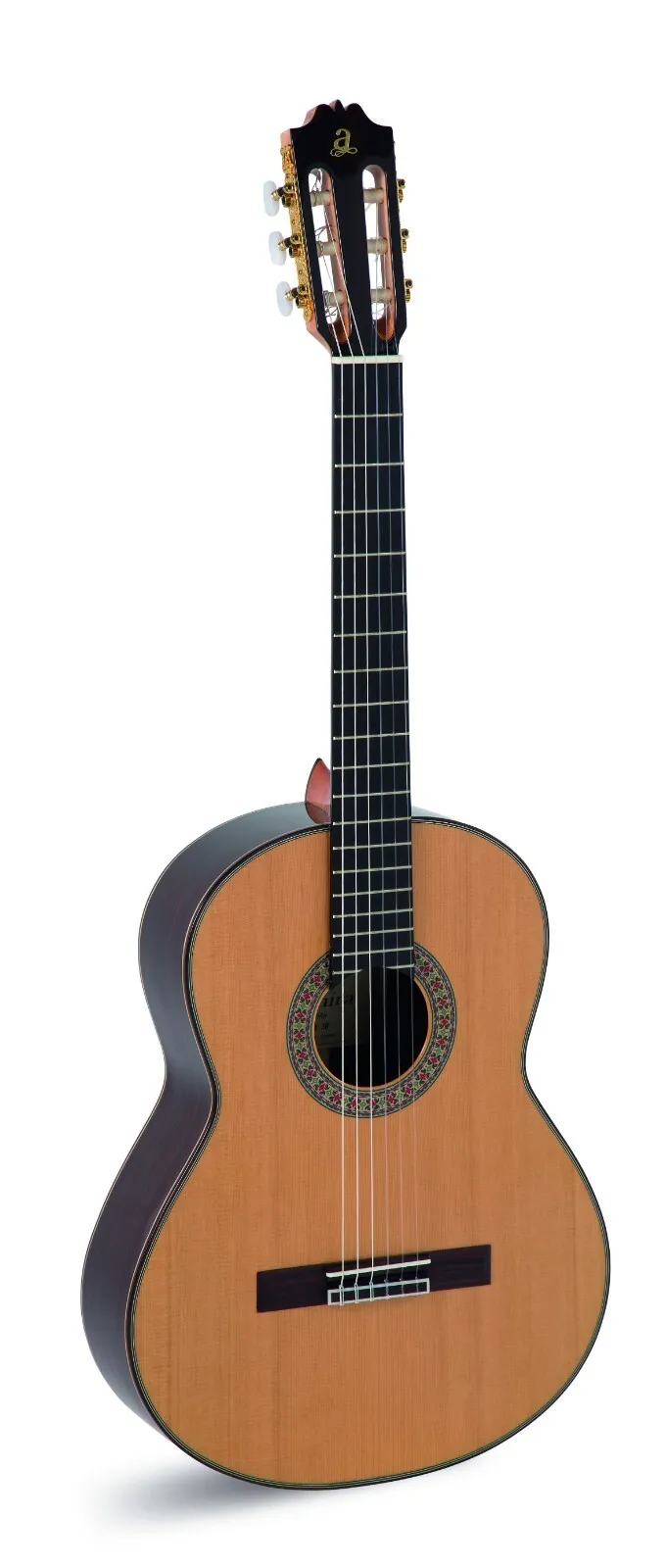
    He looked at me and said “You’re using harmonics?” I nodded. “I never thought of that. I’ve had it a few years and still can’t play. Take it, it’s yours”. That’s how I came to have a classical guitar that’s been in my possession for the last 30 odd years. It was an Admira and I found out a bit later that it would have cost him around £300.

    Recently I had the opportunity to play the latest model in that series and was excited to see if it had changed in anyway or had the same quality as mine

    If we start with the construction of mine, it’s made with the following materials

    • Top: Solid Cedar with a Satin finish.
    • Sides and Back: Rosewood with a Satin finish. Some listings mention Ovangkol, which is very similar to Rosewood in its tonal properties.
    • Neck: African Mahogany.
    • Fretboard: Mahogany.
    • Bridge: Mahogany.
    • Machine Heads: Nickel Lyre.

    These materials are chosen for their durability and contribution to the guitar’s tone and resonance. The combination of solid cedar and rosewood or ovangkol is typical for classical guitars, providing a warm, rich sound with ample volume and clarity. And 30 years later that’s still the case. It’s a beautiful instrument to play.

    But how does it compare to the A20 latest version?

    Well the construction materials are almost identical. The only difference is the newer model has an ebony fretboard and the whole thing costs more more than 4 times as much as the 1980s model at £1,290 on Amazon. That’s probably a great bargain considering how prices have risen in 30 years (a 50p pint of beer will now cost you £5.70). The sound though, well seriously it’s well named. You could pay £4,000 or more for a similar sounding guitar. It’s a joy to play. Your fingers just seem to find the right frets as if by magic, the tone can only be described as amazing and when you need to move your left hand rapidly from 1st to 3rd position your thumb slides up the neck as if it were oiled but never feels slippery. When you stop you feel secure in whatever position on the neck you happen to be. Harmonics just ring out loud and clear.

    If you want an instrument for fairly frequent performances but you don’t get paid top whack (yet), well this one will be a good investment.

    But what if you don’t have a spare £1,300 lying around or maybe you’re just starting out in classical guitar playing? Well first lets look a little at the company and ethos.

    Admira guitars are crafted with a blend of traditional Spanish guitar-making techniques and modern manufacturing systems. The process involves:The manufacturing workshops are based in Zarautz, northern Spain, where the guitars are produced to maintain the highest quality. The dedication to craftsmanship at Admira ensures that each guitar upholds the rich tradition of Spanish guitar making while incorporating modern elements for today’s musicians.

    • Selecting Woods: Admira guitars often use solid cedar for the top and Indian rosewood or mahogany for the back and sides, which are known for their tonal qualities and durability.
    • Handcrafting: While some processes are automated, the vast majority of each guitar is built and finished by hand by skilled craftsmen and women.
    • Neck Construction: The neck is typically made of mahogany with rosewood reinforcement, enhancing the instrument’s sturdiness and attractiveness.
    • Bridge: A rosewood bridge is used, aiding resonance, intonation, and tone.
    • Spanish Heel: The ARTESANÍA series, for example, is made with the union between the body and the neck of the guitar through the Spanish heel, a traditional method of construction.

    The manufacturing workshops are based in Zarautz, northern Spain, where the guitars are produced to maintain the highest quality. The dedication to craftsmanship at Admira ensures that each guitar upholds the rich tradition of Spanish guitar making while incorporating modern elements for today’s musicians.

    This applies pretty much to every guitar they make, no matter what the cost and they start at £123 for a full size guitar. It’s the Alba Student guitar. In this case, though, the word Student doesn’t apply to the musician but to the craftsperson who made it, under supervision of one of Admiras’ master luthiers. A rosewood back, sapele sides, pine top, mahogany neck means it[‘s suitable for a beginner

    Next up is the Malaga, made from spruce, mahogany and rosewood. This is a solid top guitar and you will be very hard pressed to find one of this quality and craftsmanship for £258. You’d probably get one of these, or the Concerto, when going for your grade 4 exams.

    Of course you could splash out a bit more and get the Concerto model. A cedar top and rosewood back. cedar body and mahogany neck give this guitar one of the best sounds at this price . £279

    But now we’re going to skip a few models and head to the £400 mark (£402 on the day of writing) with the A4. This instrument has a mahogany back and sides with a cedar top, mahogany with ebony reinforcements for the neck and kabakulli for the fretboard. `The neck joint is with the Spanish Heel technique, considered the most highly developed technique for this area. At this price range you’re getting serious about your guitar playing and this is an instrument that will back you all the way. an excellent sound. You just won’t get a much better guitar at this price. You’re also unlikely to get one that’s all solid wood, and it will last.

    Our last look on this visit was at the A45. This model is part of Admira’s ARTESANÍA series, which is crafted by skilled luthiers using traditional handcrafting methods to produce guitars with exceptional tone, clarity, and expression. This series represents the crown jewel of Admira’s offerings, blending top-quality materials with passionate craftsmanship. You can guess that just as the materials are superior, so is the tone and the sheer playability of this guitar. If you’re doing your B. Mus. and focussing on classical guitar this model would be up there on my list of ones to buy. £649 at the time of writing

    Disclaimer: Admira didn’t pay us, or ask us to write this review. We just happen to be very impressed by their guitars. But if you do buy from Amazon we’ll get a small commission.

  • iRig Blueturn

    iRig Blueturn

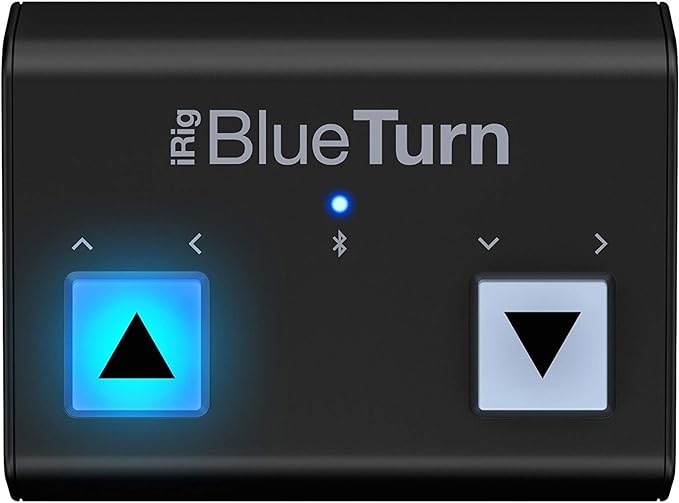
    A very simple idea to deal with a very awkward problem: I’ve got my music on a tablet but I’ve got to the bottom of the first of four pages. Now what? How do I turn the page when both my hands are on my instrument? Well not being Zaphod Beeblebrox* and not wishing to employ someone to lean over my shoulder or sit on the floor to push the button or swipe right I need a solution. Technical, not liquid (that comes later.) Well, the folk at IK Multimedia came up with a solution. Say Hello to your onstage companion for the duration of this concert, the iRig Blueturn.

    The dimensions of this piece of kit are 18.42 x 41.28 x 5.72 cm; and it weighs in at 119.07gms. It does need a couple of AAA batteries and to get you started there’s some in the box. Once you put those in you’ll notice the on-off switch underneath. That, and the two big white buttons (BWB) on the top are the only controls on the device. Do I need to tell you that the white ones are for your foot to stamp on though you’ll need to use your hands the first time you switch it on.

    Switch it on. Well actually, don’t. you see this device has a few Modes that you need to understand before you do and you have an important decision to make. OK, now you know you have to decide we can turn it on. As this is your first time hold one of the BWBs down THEN turn it on. The BWBs will flash alternately. Now, pressing the Left button will put the device into Mode 1 and, obviously, the Right will put it into Mode 2. Pressing the Left and Right together will put you into Mode 3. So what are these modes?

    Please make sure you have the up arrow foot switch on the left. Results can be unpredictable if you don’t

    The manual says Mode 1 is the most common for IOS and Android devices. Well maybe. Possibly if you’re using the Irig Stage app. This mode is the Up Arrow foot switch is like pressing the Up Arrow on your keyboard and the Down Arrow is Down. With me so far?

    If you go for Mode 2 the Up Arrow switch represent Page Up and the Down Arrow is Page Down . This is the one that works on my Android tablet but I suppose it depends on what you want the device to do as to which mode you end up choosing. Personally I would think that maybe Page Up/Down is what you might want the thing to do but you’ll need to experiment and see if the manual is right.

    Mode 3: the Left (Up Arrow) switch sends a Left Arrow command and so, quite naturally, the Right (down arrow) represents a Right Arrow command.

    Now you see why the original device orientation is important, and why, when you set out your stall, is important when in use. To help you, if the logo “BlueTurn” is upside down, so is the device.

    You’re not out of the woods yet because you still have to pair it with your device. However, that bit is dead easy. Go to you Settings > Bluetooth section and you should see it there in Other Devices, or similar grouping, where you can select it to pair. No codes need to be entered to complete the paring.

    In use, it works well and does exactly what it’s supposed to do. One caveat though. I’ve found that in direct on sunlight, even in the cold Summer days we have here in the UK (it’s mid-June as I write and the temperature is 16C) the device can stop working. Sometimes.

    At the time of writing the RRP is £79.99 but you can get it at Amazon for £74.16, or Thomonn for £66.

    *For those Earthlings not familiar with the Hitch Hikers Guide to the Galaxy, Zaphod Beeblebrox, President of said Galaxy, had a third arm fitted to help him with his ski-boxing.

  • Roadie 3

    Roadie 3

    I’ll be good, I promise, and try to avoid jokes about wind-up merchants, but I don’t promise nuffink. After all this is about a product whose whole purpose is winding things up. Well, strings anyway. On banjos, guitars, mandolins and ukuleles with breakdowns for different types of those instruments, And as if that wasn’t enough you can add in your own custom instruments and your own custom tunings. There’s 150 built-in tunings, yet you want more? Who do you think you are, Joni Mitchell?

    Ok, so there’s an obvious difference between this string winder and many others out there. This one “knows” what the string you’ve attached it to should sound like and it will stop when it gets there. If it goes a bit past it, it will retune slightly until it’s right on. You can watch the progress on the built- in screen. when the tuning is right this winder give a little self-satisfied beep, which winds you up as well.

    Oh, and it can also act as a metronome.

    I tried it out on a number of instruments – a classical guitar, recently restrung, a Yamaha acoustic in standard tuning, a Fender acoustic in Open D. a Fender Telecaster, a Gretsch resonator (steel guitar) and a mandolin. This model doesn’t handle bass guitars.

    roadie 3 case

    One word of warning. When you’re unpacking this device the cardboard moulded to the shape of the gadget fits the gadget OK, but doesn’t fit the box it comes in. It’s theoretically glued to the box but in my case this had come away. This may have happened in transit as a result of being shaken for some time, but still, be careful. This isn’t a cheap device and if you insist on dropping it on things, try to make sure they’re padded.

    Given that this device is also marketed as being useful to people “on the road” soft cover would be useful to prevent damage, especially considering the price. You can buy a hard case for it. RRP £29

    This comes with an app to download. Do so and use it. You can enter your instruments and enter their names and all details one letter at a time,. scrolling through the alphabet, but even Stephen Hawking found a better way than that. Use the app. it will save your sanity. Because….. you can do things on the app you can’t do on the device, like picking the tuning you want.

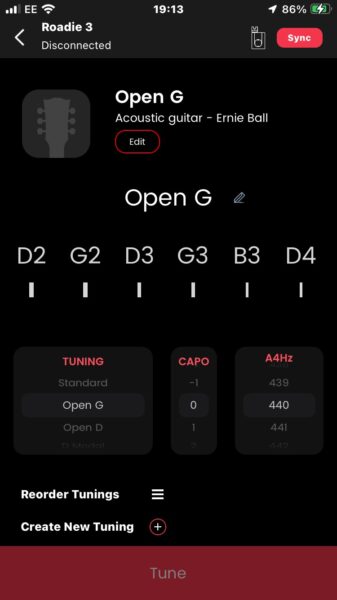
    What you’ve got here is a screenshot showing what you get when you select an instrument in the app. You get shown what each string will get tuned to, you can change the tuning in that little box marked Tuning (swipe up or down), and you’ll have noticed the really clever bit. You can set this up so that you can stick a capo on, say, the 3rd fret and have the winder get you the right tuning, so you’re not in Open G but B-flat.

    Roadie 3 screenshot

    So what’s it like to use? Well there’s a fair bit of torque in the motor so you have to keep a pretty strong grip on it. It’s also quick, apparently a lot quicker than it’s predecessor (so I’m told) and a lot quicker than other powered winders I’ve used. You do also have to keep plucking the string you’re tuning. It won’t do anything unless you do that. It doesn’t ‘listen’ to the note using a mic but instead relies on the vibrations from the string. useful in noisy environments, and essential for tuning an electric guitar. Yes, they actually don’t need to be plugged in to anything, you just tune them like an acoustic.

    It can be a bit awkward if you’ve got the guitar resting on your knee. it’s better if you can place the guitar on a rest or something that allows you access to the headstock. Otherwise you’re likely to brush the control button and maybe stop the tuning process. That means starting again. You can just pick one string, useful if you’re replacing a string on stage, but if you’ve just got to the G string it’s quicker to start again rather than select three strings manually.

    When you’ve tuned all the strings, start again anyway. Changing ther tension in any string can change the torsion in the neck and affect the tuning of strings you’ve already tuned. It’s not the device’s fault, you just can’t beat Physics. There’s also a setting called Accuracy: you can set it to Fast or High Accuracy. In a quiet room it didn’t seem to make much difference.

    It tuned the mandolin in under two minutes and each string was exactly the same as its twin. Three guitars were tuned in under five minutes. The classical guitar had just been restrung and the strings were slack. it took just a few seconds to go from slack to tuned. The electric guitar was tuned to perfection in under 20 seconds, the Yamaha in 30 seconds. It struggled a little with the resonator though but just on the top E string. That took close to a minute., but this may be because I hadn’t selected the “correct” option for the type of guitar. My three options were Lap Steel, Dobro round neck or Custom. I chose the last, maybe I should have chosen one of the others. After all this device is all about good vibrations and a resonator has a lot of those.

    If all else fails there’s a manual tuning option, just like the various tuning apps you can get for your phone.

    You can use this device to take a string off your instrument, and restring it using the WInder mode, which has 3 paces. You can unwind fas, put the new string on select the string note that you’re changing, press and hold the button and that 120RPM motor will whizz it up for you you and stop at the right note. In theory. It can be a little precious in doing that.

    The battery is supposed to be able to handle 150 strings being tuned before it needs a recharge (USB-C cable supplied).

    The claim is made that if your instrument has geared pegs then this device can tune it, so if you play the violin or viola you’re out of luck. Maybe. You probably have a violin which relies on friction to keep it in tune, you know, pull, tune, push, check. Swear. Start again. For. Each. String! Or you could buy a set of geared pegs. These will set you back anything from just under a tenner to £200 for a set. Now this gadget will work for you as well.

    This is an impressive little device (it’s smaller than the palm of my hand, but I have reasonably large hands (stretching to 10 white notes on the piano – not up there with Liszt or Poulenc but not baby paws). First contact, it feels like it’s worth the £129 RRP (£107.50 at the time of writing). If you’re playing regularly on stage and under lights it might well be worth having one to give your axe a quick sharpening when you feel it’s needed. Get one for your roadie. For me, i do most of my playing these days on the beach, in the hot sun where sometimes you can hear the tuning drift during the course of a single song. It’s going to get a work out over the summer, so I’ll come back and give an update after I’ve used it in anger.

    I also think I kept my promise and avoided obvious puns. Don’t expect that to happen again.

    3 Month Update

    It’s not totally happy down at the beach. for some reason it doesn’t seem to like the wind and ends up winding up and down past the note several times before deciding it’s OK, then you play a chord and find 2 or 3 notes are out. Or it decides that what you really, really wanted to do was unwind that string, not tune it up. Nothing you can do will stop it except to turn it off, manually retune the string a bit and try again. Is it the noise? Because if it is I’d have difficulty recommending one for gigging. It’s not every time but it’s happened to me three times so far, once at home twice by the sea. Could just be a glitch. If you’ve got one and have anything to add please leave a review

    Knilling Perfection Planetary Pegs, Violin £99

    Wittner Medium FInetune Violin Peg £69

    Toyandona Geared Pegs for Violin £30

    Roadie 3 at Amazon

    Roadie 3 case at Amazon

    Roadie Bass Tuner at Amazon

The Music Realm
Privacy Overview

This website uses cookies so that we can provide you with the best user experience possible. Cookie information is stored in your browser and performs functions such as recognising you when you return to our website and helping our team to understand which sections of the website you find most interesting and useful.